By Legends Sports & Pool Bar Editorial Team · Updated 7 August 2026
The right work team building activities match a clear workplace goal, suit the people taking part and make participation feel comfortable rather than forced. Start by deciding whether your team needs better communication, stronger relationships, renewed energy or simply time to relax together. Then choose a format that gives everyone a meaningful way to join in.
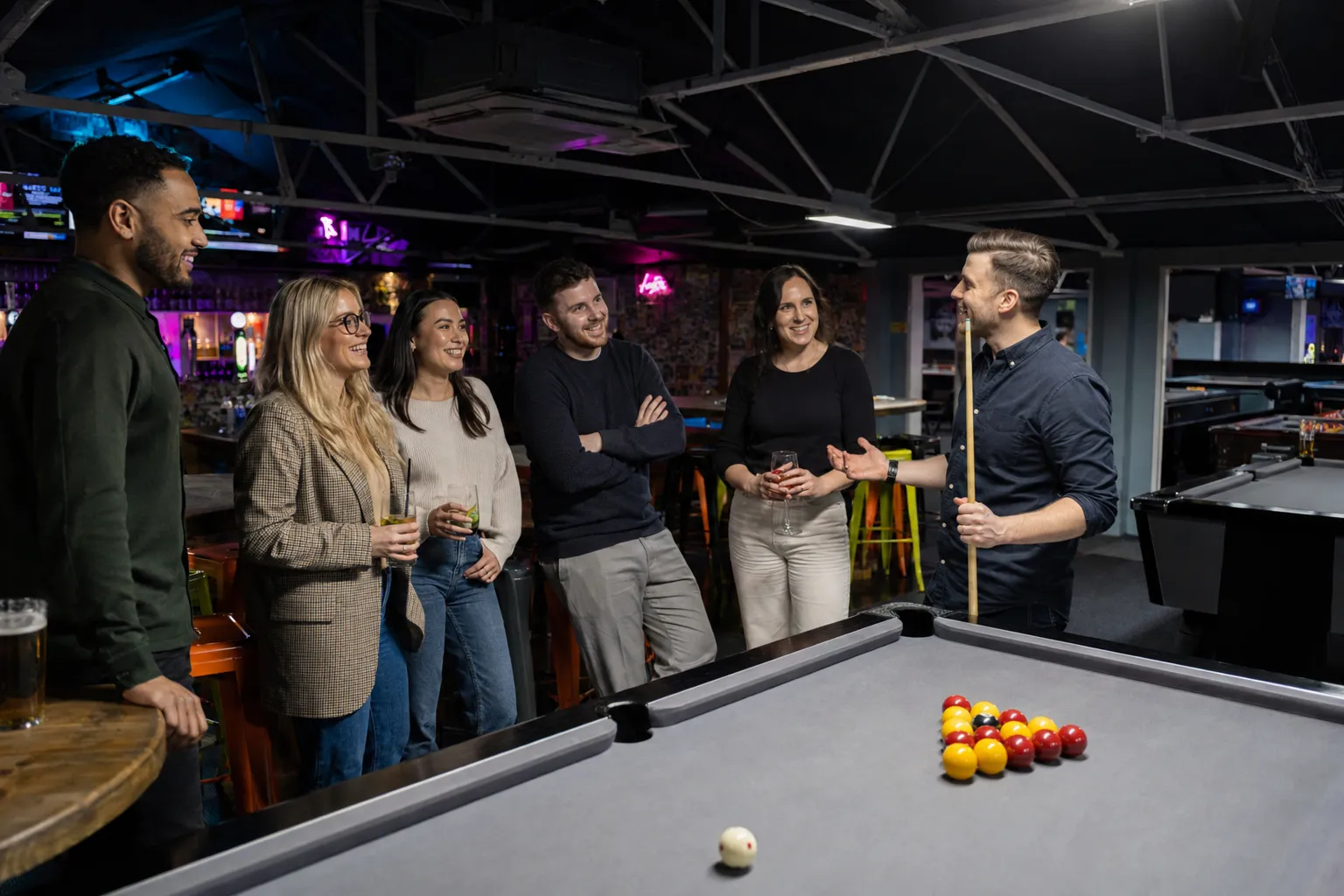
At Legends Sports & Pool Bar in Braintree, companies can build an event around English or American pool, darts, shuffleboard, food, drinks and live sport. These activities create natural conversation and friendly competition without turning a staff social into another formal meeting. With free on-site parking, no membership requirement and group booking options, Legends offers an easy setting for team nights, company celebrations and corporate team building in Essex.
Key Takeaways
- Begin with one clear objective, such as helping new colleagues connect, improving communication or thanking the team after a busy period.
- Consider group size, confidence, mobility, time, budget and appetite for competition before choosing an activity.
- Pool, darts and shuffleboard can support different goals when teams, rules and scoring are designed thoughtfully.
- Make space for conversation, food and breaks so the event feels social rather than over-managed.
- Legends provides 10 English pool tables, two full-size American pool tables, five dart boards and one 14ft shuffleboard table.
- Companies can enquire about corporate packages, private hire, sports viewing parties and tailored food and drink arrangements.
What Should You Decide Before Choosing an Activity?
Do not begin with a long list of team building games. Begin with the change you want the event to support. A fun afternoon can still be worthwhile, but a clear purpose helps you select the right tone, activity and level of structure.
Ask these questions first:
- Why are we bringing people together? Is the priority onboarding, employee engagement, cross-team communication, recognition, morale or a simple social?
- Who will attend? Consider team size, existing relationships, confidence levels and any individual requirements.
- How should the event feel? Decide whether the group would enjoy a lively competition, a relaxed social or a mixture of both.
- How much time is available? A 60-minute activity needs a different format from a half-day offsite.
- What practical limits matter? Set an approximate budget, preferred date, travel area and food or drink requirements.
This initial thinking prevents a common mistake: choosing an activity because it is popular, then trying to force it onto the team. Good team activities for work should fit the people in the room. They should not rely on embarrassment, unwanted personal disclosure or intense physical contact to create energy.
The CIPD evidence review on trust and psychological safety explains that both concepts are linked with important individual and team outcomes. That does not mean one social event can manufacture trust. It does mean organisers should choose formats in which teammates can contribute, make mistakes and communicate without being ridiculed.
How Do You Match Team Building to a Workplace Goal?
Different goals require different types of interaction. If colleagues rarely speak, the event should create easy conversation. If the team has recently changed, rotating partners may be more useful than keeping established friendship groups together. If everyone is tired after a demanding project, a tightly facilitated problem-solving exercise may feel like more work.
Use this activity-selection table as a starting point:
| Team goal | What the activity should create | Suitable Legends format | Organiser’s role |
|---|---|---|---|
| Help new colleagues connect | Short, repeated interactions | Pool doubles with rotating partners | Mix departments and explain the rules simply |
| Improve communication | Shared decisions and turn-taking | Team pool or shuffleboard pairs | Reward clear calls and encouragement |
| Rebuild energy | Quick rounds and visible progress | Darts team challenge | Keep scoring light and rounds moving |
| Strengthen collaboration | A common team score | Mixed pool, darts and shuffleboard league | Combine individual results into one total |
| Thank the team | Choice, food and relaxed conversation | Casual games followed by food and live sport | Avoid over-scheduling the evening |
| Connect departments | New pairings and low-pressure introductions | Rotating activity stations | Prevent existing groups from staying separate |
Choose connection when the team is new
For a newly formed group, the best team ice breakers for work are easy to understand and do not demand personal revelations. Pairing colleagues for a short game of pool gives them something to focus on while conversation develops naturally. Change partners after each round so people meet beyond their immediate role or department.
A small team icebreaker can be as simple as asking each pair to choose a team name and agree on one playing tactic. That prompt encourages communication without making anyone perform in front of the entire group. It is often more comfortable than two truths and a lie, charades or pictionary, particularly when colleagues do not yet know one another well.
Choose shared decisions when communication is the goal
If the aim is to improve communication, use games in which people must discuss options before acting. In doubles pool, teammates can assess the table, agree which shot to attempt and decide how ambitious to be. In shuffleboard, pairs can talk about placement, risk and defence before each turn.
The organiser does not need to lecture people about communication. The format creates small moments in which colleagues listen, suggest and adapt. A short reflection at the end can help participants notice what worked: Did the pair share ideas? Did one person dominate? How did they respond after a missed shot?
Choose variety when employee engagement is the goal
Employee engagement games work best when people can participate in more than one way. Some colleagues will enjoy aiming for the top score. Others may prefer keeping results, encouraging a partner, taking photographs or helping the team decide its next move.
A mixed-games rotation supports this variety. It also prevents one experienced pool player from deciding the whole event. Combining pool, darts and shuffleboard gives different people a chance to contribute and can encourage teamwork across a broader range of skills.
Choose freedom when the team needs a reward
Not every event needs a lesson attached. After a difficult deadline or successful project, the purpose may simply be to recognise the team’s effort. In that case, the best work outing ideas leave room for food, drinks, conversation and optional games.
Trying to convert every minute into a learning outcome can make fun work activities feel artificial. Set up a light competition for those who want it, but allow others to watch live sport or catch up between rounds. Enjoyment and genuine connection are valid aims.
What Practical Factors Should Shape Your Choice?
An activity can match the objective perfectly and still fail if the format ignores the group. Before confirming a plan, check the following practical factors.
Group size and flow
Smaller groups can stay on one game for longer, while larger groups benefit from rotation. Avoid promising a universal ideal number. The right arrangement depends on the selected activities, available space, booking time and whether people will play simultaneously.
For a larger group, divide attendees into smaller teams and give each one a starting activity. Build in a clear signal for moving stations. For a small group, doubles or pairs formats make it easier for everyone to remain involved.
When enquiring, give Legends your expected number of attendees and preferred games. The team can discuss available options rather than relying on an invented capacity or a generic ratio.
Confidence and experience
Workplace group activities should not reward only the most experienced players. Ask whether anyone plays pool, darts or shuffleboard regularly, then spread confident players across different teams. Explain rules briefly and allow a practice turn before scoring begins.
Mixed-ability formats can also use a handicap, alternative points system or sportsmanship bonus. The aim is not to remove competition. It is to keep the result open long enough for beginners to stay engaged.
Accessibility and personal comfort
Ask attendees privately about access or participation requirements before the event. A person may need more seating, regular breaks, a quieter role or an alternative way to contribute. Do not ask colleagues to disclose personal information in front of the group.
The current Legends website describes the venue as disabled-friendly, but organisers should still discuss individual requirements directly when booking. Specific needs vary, and checking in advance is more useful than making assumptions.
Avoid activities involving forced touch, blindfolding or personal disclosure unless every participant has freely agreed. A human knot or minefield exercise may appear on generic lists, but physical closeness and trust-based instructions can make some people uncomfortable. Inclusive team building creates choice.
Time and energy
Match the activity intensity to the point in the working week. A short after-work social should be simple to join. A longer work retreat can accommodate an opening icebreaker, several rounds, food and a brief debrief.
Allow time for arrivals, rule explanations, food orders and natural conversation. A schedule with no breathing space quickly feels like project management rather than a social occasion.
Budget and booking details
Decide the approximate total or per-person budget before requesting options. Ask what is included, how activities are booked, whether private hire is required, and what food and drink arrangements are available. Confirm the date, timings, payment terms and cancellation conditions directly rather than assuming they are standard.
Legends offers tailored corporate food and drink packages, private hire enquiries and regular group bookings. Advance booking is recommended for group events and busy periods, although walk-ins are welcome. If your company expects to return regularly, the Players Club Card costs £10 per year and gives 20% off pool table and shuffleboard hire. It is a discount card, not a requirement for entry or a venue membership.
Which Team Building Activities Can You Choose at Legends?
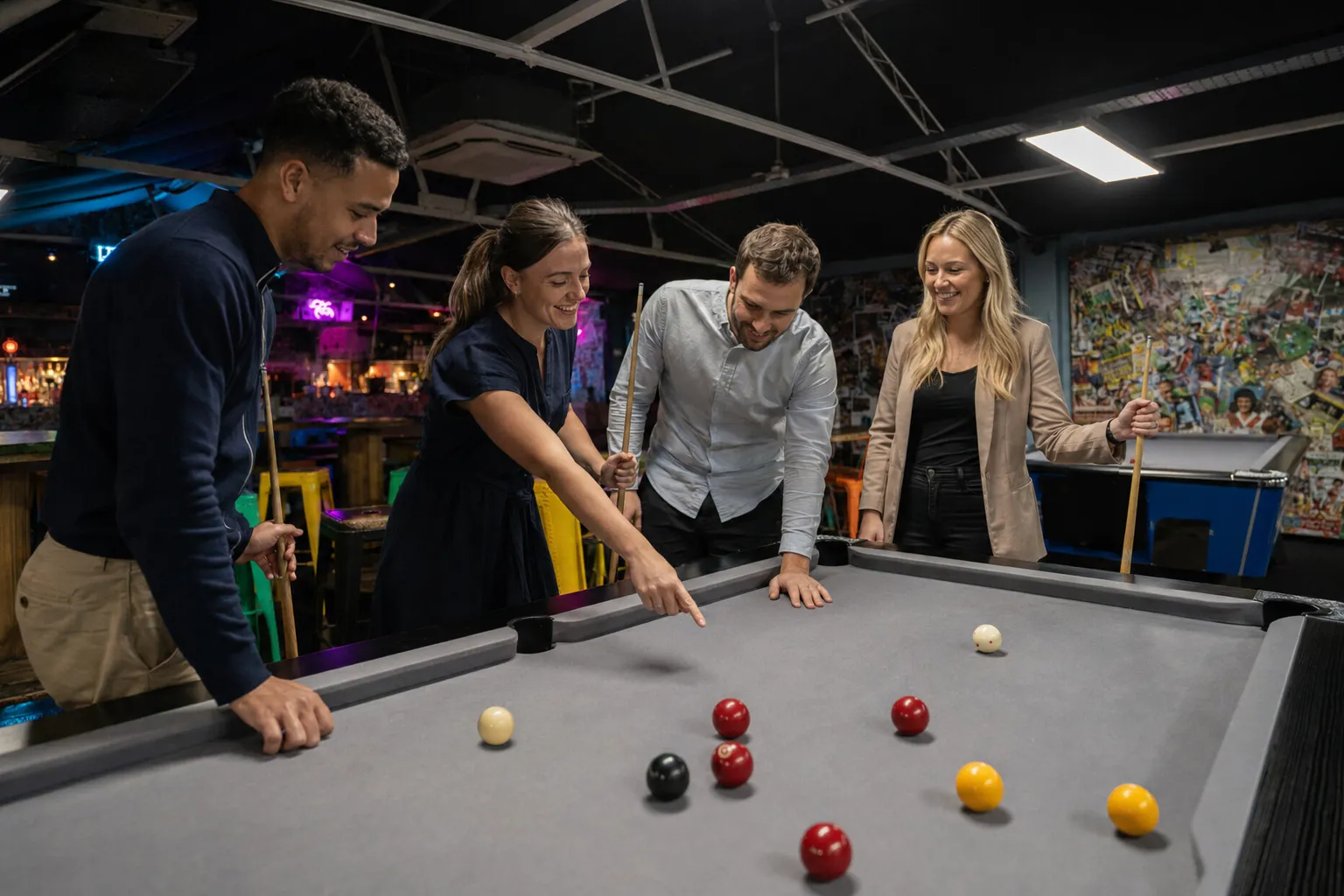
Legends’ pool and games can be organised in several ways. The choice should follow the team’s goal rather than a fixed template.
Pool doubles for communication
Pool doubles works well when you want colleagues to talk, plan and support one another. Pair people from different roles and ask each duo to discuss its shot before playing. Use short matches so pairs meet more than one opponent.
Possible scoring:
- Two points for a win.
- One point for completing the match within the round.
- One optional sportsmanship point for encouragement and fair play.
Legends has 10 English pool tables and two full-size American pool tables. The two styles offer useful variety, but the organiser should confirm which tables and booking times are available for the preferred date.
Darts for quick energy
Darts can create fast rounds and clear progress. Legends has five dart boards, and darts are free with any purchase. Divide colleagues into balanced teams and select a simple target-based game. Keep the format accessible for beginners and explain safe throwing and collection rules before play.
One option is a cumulative score challenge in which every participant throws a set number of darts and adds their result to the team total. This helps quieter participants contribute without having to perform alone for long.
Shuffleboard for shared strategy
The 14ft shuffleboard table suits pairs or small teams. It is quick to understand, yet it introduces choices around placement, blocking and risk. Give each pair a practice round, then run short fixtures or a target-score challenge.
Shuffleboard is particularly useful when you want an activity with a gentler pace. Colleagues can collaborate on tactics while the rest of the team watches, talks and encourages the players.
A mixed Legends league for variety
A mixed league lets teams earn points across pool, darts and shuffleboard. It suits company group activities where people have different preferences and experience levels.
Use three principles:
- Keep every round short enough for teams to rotate.
- Count results towards one shared total so no single game decides the winner.
- Add a small teamwork or sportsmanship score to recognise encouragement, inclusion and fair play.
This format can encourage teamwork without making the event overly serious. It also gives people natural breaks to speak with colleagues between stations.
Live sport as a social finish
If a major fixture is relevant to the group, live sport at Legends can become the relaxed final part of the event. The venue shows sport on multiple HD screens, including football on Sky Sports, TNT Sports and Amazon Prime.
A sports viewing party works well after the structured activity. It gives the group a shared focus while allowing conversation to continue over food and drinks. Check the fixture and screening details with Legends when planning.
How Do Legends Activities Compare With Other Team Building Ideas?
Search results often mix in-office exercises, virtual activities, physical challenges and paid attractions. These can all suit particular teams, but they create different experiences. Legends provides pool, darts, shuffleboard, food, drinks and live sport. It does not offer the other activities listed below.
| Activity type | Can be useful when | Points to consider | Available at Legends? |
| Office trivia or a memory wall | The group wants an inexpensive team meeting activity | Requires preparation and may feel work-focused | No |
| Two truths and a lie, charades or pictionary | A confident group enjoys verbal or performance-based icebreakers | Some colleagues may dislike performing or sharing personal facts | No |
| Escape room challenge or murder mystery | The team enjoys a single themed problem | May restrict conversation and flexibility | No |
| Human knot or minefield | Participants have freely agreed to physical or trust-based tasks | Contact, blindfolds and mobility demands require care | No |
| Virtual games for work | Remote colleagues cannot meet in person | Screen fatigue can limit informal conversation | No |
| Pool, darts and shuffleboard | The team wants flexible, face-to-face games with food and drinks nearby | Needs sensible rotation and balanced teams | Yes |
Fun virtual games for work can connect distributed colleagues, while fun employee engagement activities in office settings can work with limited travel or budget. A memory wall may support reflection, and office trivia can celebrate shared knowledge. Those are different from an external team social.
Similarly, an escape room challenge, murder mystery or branded offsite may suit a group that wants a single immersive theme. Work retreat ideas may combine planning sessions with leisure over a longer period. Legends is better suited to an informal, sports-led social, activity session, after-work gathering or one part of a wider retreat itinerary.
The useful question is not, “Which activity sounds most impressive?” It is, “Which setting will help this group participate comfortably and connect?”
How Can You Design an Inclusive Team Event?
Inclusive team building activities for work give people choice, clear information and more than one way to contribute. They do not assume every colleague enjoys public competition.
1. Tell people what to expect
Share the location, arrival time, approximate finish, travel details, planned games, food arrangements and dress guidance. Mention that Legends is a non-membership venue with free on-site parking. Invite attendees to raise individual requirements privately.
2. Build balanced teams
Mix roles, departments and experience levels. Avoid putting all managers or confident players together. When colleagues collaborate with people outside their usual circle, the activity can support wider workplace relationships.
3. Give everyone a role
Not everyone needs to take the same number of shots. Teams can have players, scorers, timekeepers, tacticians and supporters. Rotate roles where practical so participation stays varied.
4. Keep rules simple
Explain the activity in a minute or two, demonstrate one example and allow questions. Long instructions drain energy. If a rule becomes confusing, simplify it rather than debating technical details.
5. Reward the behaviour you want
If the goal is collaboration, do not score only the final result. Add points for clear communication, support, fair play or including every teammate. This aligns the competition with the purpose of the event.
6. Avoid forced fun
Offer a route to participate without taking centre stage. Allow someone to score, observe or join the next round if they prefer. Empathy from the organiser matters more than rigid compliance with a schedule.
7. Finish with a light reflection
A debrief can be brief and conversational. Ask:
- What helped your team make decisions?
- When did communication work best?
- How did the group respond when a plan failed?
- What would you repeat back at work?
Google’s research into team effectiveness highlights psychological safety, dependability, structure and clarity, meaning and impact as important team dynamics. Use the reflection to notice behaviours, not to declare that one evening has fixed the company culture.
Three Ready-to-Use Event Formats
The following templates can help an organiser turn broad team bonding ideas into a workable plan. Exact timings and activity availability should be confirmed with Legends.
Format 1: Relaxed 90-minute team social
Best for: a thank-you, new-starter welcome or informal after-work gathering.
| Time | Activity |
| 0:00 to 0:15 | Arrivals, drinks and team allocation |
| 0:15 to 0:50 | Pool doubles or darts challenge |
| 0:50 to 1:10 | Shuffleboard bonus round |
| 1:10 to 1:30 | Food, results and conversation |
This keeps structure light. It works well for fun work group activities where connection matters more than formal learning.
Format 2: Two-hour mixed-games challenge
Best for: cross-department collaboration or a larger company social.
| Time | Activity |
| 0:00 to 0:15 | Welcome, rules and practice |
| 0:15 to 0:45 | Rotation one |
| 0:45 to 1:15 | Rotation two |
| 1:15 to 1:45 | Rotation three |
| 1:45 to 2:00 | Final scores and brief reflection |
Teams collect points across pool, darts and shuffleboard. This creates varied team work activities and reduces the advantage of experience in one game.
Format 3: Games, food and live sport
Best for: celebration, client entertainment or an end-of-project reward.
Begin with one structured game, move into food and drinks, then watch a selected fixture together. This format gives the group a shared activity without filling the whole visit with instructions. It is a strong option for team games for work when the main goal is social connection.
Why Choose Legends for Team Building in Braintree?

Legends’ team-building options in Braintree suit businesses looking for indoor, sports-led group activities for work. The venue brings several practical elements together:
- 10 English pool tables.
- Two full-size American pool tables.
- Five dart boards, with darts free with any purchase.
- One 14ft shuffleboard table.
- Multiple HD screens showing live sport.
- Classic burgers with fries, stone-baked pizzas, hearty mains, sharing plates and bar snacks.
- A fully stocked bar with hot, cold and soft drinks available.
- Corporate food and drink packages.
- Private hire enquiries for exclusive access to the games area.
- Free on-site parking.
- No membership requirement.
- A welcoming, family-run setting in Braintree, Essex.
For companies comparing corporate team building in Essex, the main advantage is flexibility. The same visit can combine light competition, informal conversation, food, drinks and live sport. Organisers can choose how structured the event should feel.
Legends has been bringing the community together since 2015. It welcomes walk-ins, but advance arrangements are recommended for corporate groups, private hire and busy periods. Use the group booking enquiry to share your preferred date, approximate attendance, activity ideas, food and drink requirements and rough budget.
Frequently Asked Questions
What makes a work team building activity effective?
An effective activity has a clear purpose, suits the people taking part and creates meaningful interaction. It should offer simple instructions, balanced participation and enough flexibility for different confidence levels. The activity is a prompt for better interaction, not a guaranteed fix for workplace problems.
Which activities are best for improving communication?
Choose activities that require shared decisions and turn-taking. Pool doubles and shuffleboard pairs can prompt teammates to discuss tactics, listen and adapt. The organiser can strengthen this by rotating partners and rewarding supportive communication.
What are good team bonding games for work?
Good team bonding games for work feel sociable, inclusive and appropriate for the group. Pool, darts and shuffleboard can work well because rules can be simplified, teams can be balanced and colleagues have time to talk between turns.
Are pool, darts and shuffleboard suitable for beginners?
Yes, when the event includes a short explanation, practice time and mixed-ability teams. Keep scoring friendly and give participants different ways to contribute. Confirm individual access needs before booking.
What are some fun group activities for workplace teams?
At Legends, workplace teams can organise pool doubles, a darts team challenge, shuffleboard pairs or a mixed-games league. Groups can also combine games with food, drinks and live sport. These fun group activities for workplace teams can be adapted to a relaxed social or a more structured competition.
Can Legends host team bonding activities for work?
Yes. Legends accepts corporate and group enquiries for pool tournaments, darts competitions, shuffleboard challenges, private hire, sports viewing and tailored food and drink packages. Discuss the preferred format directly through the group booking page.
Do we need to become members?
No. Legends is a non-membership venue. The optional Players Club Card is a paid discount card for regular visitors, not a condition of entry.
How do we book a company event?
Send Legends your preferred date, approximate group size, timing, activities, food and drink requirements, and rough budget. Advance booking is recommended for company group activities. You can use the Legends contact page or the group booking form.
Choose an Activity Your Team Will Actually Enjoy
The best work team building activities are not the most complicated. They are the ones that fit the team’s goal, respect individual comfort and create genuine opportunities to speak, laugh and contribute.
Legends makes it possible to build an event around pool, darts, shuffleboard, food, drinks and live sport in one Braintree venue. Whether you are researching team meeting activities, work retreat ideas, team bonding activities for work or a simple staff social, start with the people and purpose. Then choose a format that makes participation easy.
Enquire about a group booking at Legends with your preferred date, approximate attendance, chosen activities, food and drink requirements and budget. The team can discuss a suitable plan for your workplace.