
By Legends Sports & Pool Bar Editorial Team · Updated 2026-08-07
The best work group activities give colleagues something enjoyable to do together while creating natural opportunities to talk, plan and support one another. At Legends Sports & Pool Bar in Braintree, pool tournaments, darts competitions and shuffleboard challenges turn a company social into a shared experience without making it feel like another day at the office.
Legends is a family-run, non-membership venue with 10 English pool tables, two full-size American pool tables, five dart boards and one 14ft shuffleboard table. Businesses can also discuss private hire, tailored food and drink packages, informal meeting space and sports viewing parties. Free on-site parking makes the practical side of bringing a team together easier.
This guide explains how to choose work group activities for different aims, plan inclusive formats and turn the games available at Legends into a lively team event in Braintree or Essex.
Key Takeaways
- Effective team building gives everyone a role, keeps the stakes friendly and creates time for conversation.
- Pool, darts and shuffleboard can encourage communication, teamwork, trust and camaraderie through shared decisions and friendly competition.
- Small teams and rotating pairs help colleagues interact beyond their usual departments or friendship groups.
- A mixed-games format gives different personalities and experience levels several ways to contribute.
- Legends welcomes walk-ins, but advance booking is recommended for company groups, busy periods and private hire.
- Organisers can send a group booking enquiry with their date, expected attendance, preferred games, food requirements and approximate budget.
What Makes Work Group Activities Effective?
Useful team activities have a clear purpose, simple rules and a format that allows everyone to take part. They do not need to be complicated. In many cases, colleagues gain more from a shared challenge they can understand quickly than from an elaborate exercise that needs a long explanation.
The CIPD evidence review on high-performing teams identifies trust, psychological safety, team cohesion, shared thinking, information sharing and reflection as important team dynamics. It also recommends well-planned interventions, including team building, teamwork training, debriefing and goal setting.
A social event cannot fix every workplace problem. It can, however, give teammates a different setting in which to practise listening, decision-making, encouragement and adaptability. A pool doubles match asks two people to agree a plan. A darts round gives the whole side a reason to support the next player. Shuffleboard rewards patience and shared strategy. These are small interactions, but they can reveal strengths that are less visible in routine meetings.
Why does a shared challenge help people connect?
A shared challenge provides an immediate topic of conversation. Colleagues do not have to invent small talk because the next shot, score or tactic gives them something to discuss. Roles also become more flexible. A manager may ask a new starter for advice, while a quieter team member may recognise the best route around the pool table.
These moments can support empathy and collaboration when the atmosphere is welcoming. Google’s research into team effectiveness highlights psychological safety as a key team dynamic. An organiser can encourage it by treating mistakes lightly, inviting different ideas and making it safe for people to say that they are unsure.
What separates enjoyable activities from awkward ones?
Strong group activities usually share five qualities:
- Easy to understand: People can begin after a short explanation.
- Inclusive: New and experienced players both have meaningful roles.
- Social: The format leaves room to chat between turns.
- Flexible: Teams, timings and scoring can change to suit the group.
- Low pressure: Results add energy without embarrassing anyone.
Good facilitation matters, even for an informal event. The organiser should explain the aim, set a friendly tone and prevent one confident person from taking every decision. The best team building games feel like play first. Any workplace learning happens through the experience and the brief reflection afterwards.
Which Work Group Activities Can You Run at Legends?
Legends offers three confirmed game-based options for corporate team building: pool tournaments, darts competitions and shuffleboard challenges. These can be played separately or combined into a points-based league.
Groups can view the pool and games available at Legends before deciding which format best suits their event.
1. Pool doubles league
Pool is one of the most adaptable work team games because colleagues must balance individual execution with shared tactics. Legends has 10 English pool tables and two full-size American pool tables, so a group booking can use several matches to keep people involved.
A simple doubles league can work as follows:
- Divide the group into balanced pairs.
- Give each pair a short practice period.
- Run several timed or single-frame matches.
- Award points for each result instead of eliminating teams immediately.
- Rotate partners for a second round.
- Finish with a short final or a mixed-team challenge.
Ask pairs to discuss their intended shot before playing. They do not have to follow the suggestion, but the conversation encourages clear communication and shared decision-making. Pairing an experienced player with a beginner can also create informal coaching without making the event feel like formal training.
For a less competitive group, remove the league table and set a joint target instead. The pair might try to pot a certain number of balls, complete a frame within a time window or improve on its previous result. This keeps the focus on progress and teamwork.
2. Darts team challenge
Legends has five well-maintained dart boards, and darts are free with any purchase. The organiser can create several short rounds so everyone throws regularly and no single player determines the whole result.
Possible rounds include:
- Highest combined team score from a fixed number of darts
- Nearest to the bull
- Target ladder using a sequence of numbers
- Team countdown where every player must contribute
- Accuracy round with bonus points for improvement
Let each side choose its throwing order. That decision prompts a quick discussion about confidence, pressure and tactics. Encourage teammates to offer positive support rather than technical criticism. The format should build camaraderie, not turn an informal event into a test.
3. Shuffleboard pairs challenge
The 14ft shuffleboard table offers a game that beginners can understand quickly. Players need to judge speed, position and risk. A shot may score directly, protect another puck or remove an opponent’s advantage.
Use pairs and ask them to agree a plan before each turn. Rotate partners after a set number of ends so colleagues collaborate with people outside their normal working circle. Shuffleboard can also act as an icebreaker at the start of a company event because the rules are simple and the action creates conversation immediately.
4. Mixed Legends games league
A mixed league combines pool, darts and shuffleboard into one event. This is one of the most flexible team work activities because it rewards different strengths. A strong pool player may help in one round, while a calm darts player or strategic shuffleboard partner becomes important in another.
| Station | Example format | Behaviour encouraged |
|---|---|---|
| English or American pool | Doubles match | Planning and clear communication |
| Darts | Combined-score challenge | Focus and mutual encouragement |
| Shuffleboard | Pairs contest | Patience and shared strategy |
| Final round | Mixed challenge | Adaptability and team support |
Keep the scoring simple. Three points for a win, two for a draw and one for completing the round is enough. You can also award a bonus point for sportsmanship, the best comeback or the clearest teamwork. This prevents the event from rewarding ability alone.
5. Sports prediction add-on
Legends shows major fixtures on multiple HD screens, including football on Sky Sports, TNT Sports and Amazon Prime, plus rugby, Formula 1, golf, boxing and women’s football. If an appropriate fixture is scheduled during the booking, colleagues can submit predictions before play or complete a short trivia round.
Treat this as an optional social extra. The main activities should still work for people who do not follow sport. Check live sports at Legends, review the venue’s upcoming events and confirm the fixture directly before arranging the event, as broadcast schedules can change.
How Do You Choose the Right Team Building Format?
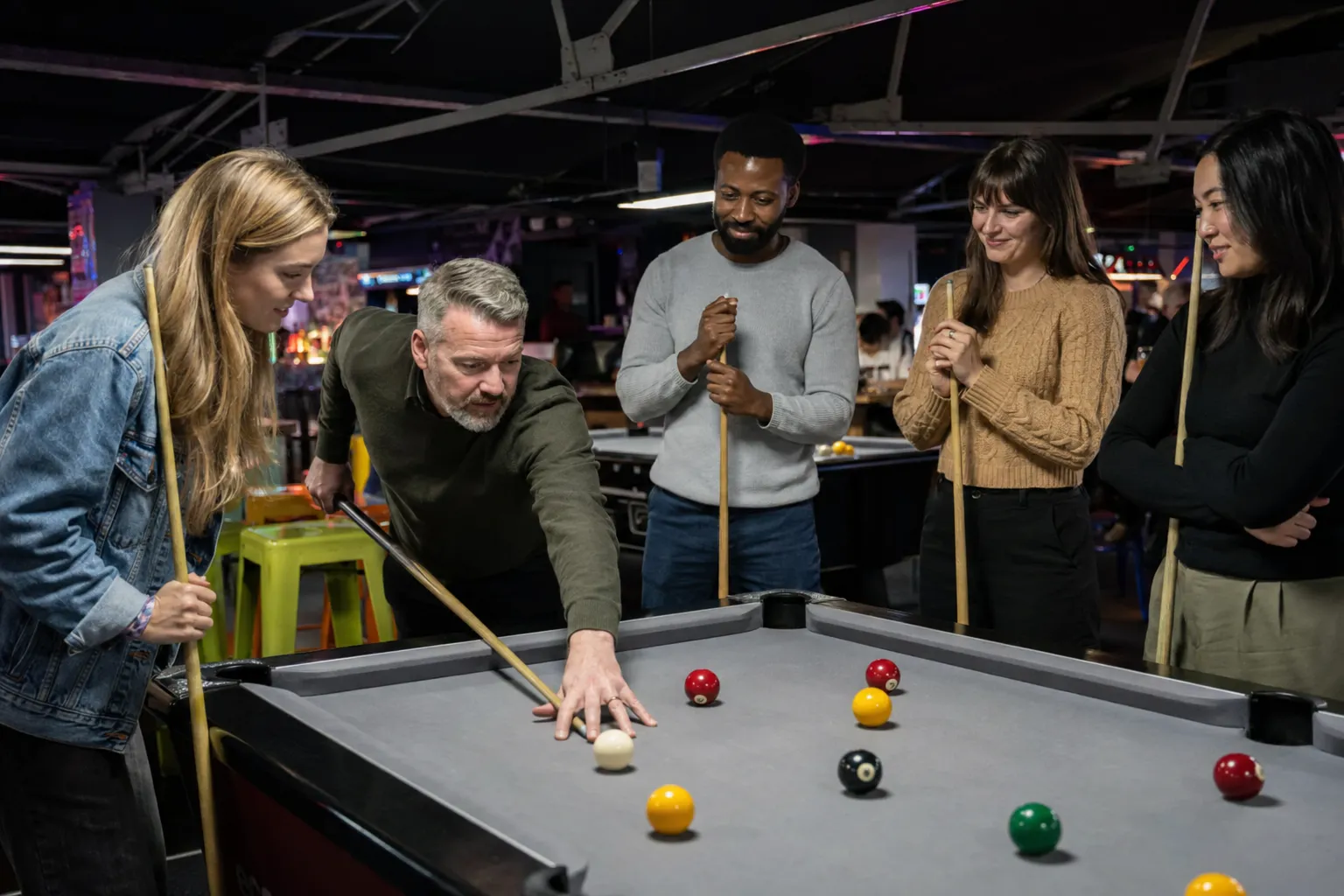
Begin with the reason for bringing people together. Different aims need different formats, and trying to address everything at once usually leads to a muddled event.
| Main aim | Suitable format | Simple design choice |
| Help new colleagues meet | Rotating pairs | Change partners between short rounds |
| Improve communication | Pool doubles | Ask pairs to agree tactics before each shot |
| Encourage trust | Mixed-ability teams | Give every participant a clear role |
| Build collaboration | Mixed-games league | Combine scores across several activities |
| Celebrate a result | Casual tournament and food | Keep structure light and allow social time |
| Connect departments | Cross-team rotation | Avoid keeping usual work groups together |
Team bonding activities for work should match the confidence and needs of the people attending. Ask whether anyone prefers not to compete, has an access requirement or has never played the selected games. Nobody should be surprised by an activity that depends on physical contact, public performance or specialist skill.
How do small groups benefit?
Team building small group activities make participation visible. In pairs or small sides, each person gets a turn and can influence the outcome. These formats also make it easier to change partners, so colleagues meet more people during the session.
Small group activities for adults work best when the rules respect people’s time and confidence. One pool table, dart board or shuffleboard table can support a focused mini-league. For larger bookings, several small groups can play simultaneously and then come together for a final.
People searching for group activities for small groups do not necessarily need a private room or complicated equipment. A reserved game, a scorecard and a clear rotation can be enough to create structure while leaving the event relaxed.
How do larger groups stay involved?
Divide a larger party into teams before the first round and give each one a simple schedule. Avoid a long knockout competition where people are eliminated early. Points-based rotations keep more colleagues active and give every team another chance after a loss.
Use non-playing roles carefully. A person can keep score, watch the time or help choose tactics, but these roles should rotate so nobody spends the whole event on the side. If the group includes several departments, mix the first teams and change the line-up later.
How Can Organisers Make Team Building Inclusive?
Inclusive team building does not mean removing competition. It means designing the competition so different people can contribute and nobody is made uncomfortable for the sake of entertainment.
Balance experience levels
Ask about experience informally, then spread confident players across the teams. Offer practice turns and explain the basic rules without assuming prior knowledge. For pool, use doubles. For darts, count a combined score. For shuffleboard, let pairs discuss every shot.
Offer more than one way to contribute
Some people enjoy playing under pressure, while others are better at planning, encouragement or keeping the group organised. Let teammates take turns as captain, player and tactician. This helps reveal hidden strengths and keeps one personality from dominating.
Keep the language positive
Replace criticism with useful questions. Ask, “What could we try next?” rather than focusing on who missed. Celebrate improvement, creative thinking and support as well as wins. This can encourage innovation without forcing anybody to perform an artificial creative exercise.
Avoid forced contact or disclosure
Popular team ice breakers for work can include two truths and a lie, the human knot or personal question games. These formats may suit some teams, but they can also involve unwanted disclosure or physical contact. A small team ice breaker based on choosing a team name, predicting a score or taking a practice turn is easier to control and keeps the focus on the shared event.
Fun team ice breakers should reduce tension, not create it. Give people a clear opt-out and never require personal information. The same principle applies to team meeting activities and team bonding games for work: participation should feel welcoming rather than compulsory.
How Do Legends Activities Compare With Other Group Ideas?
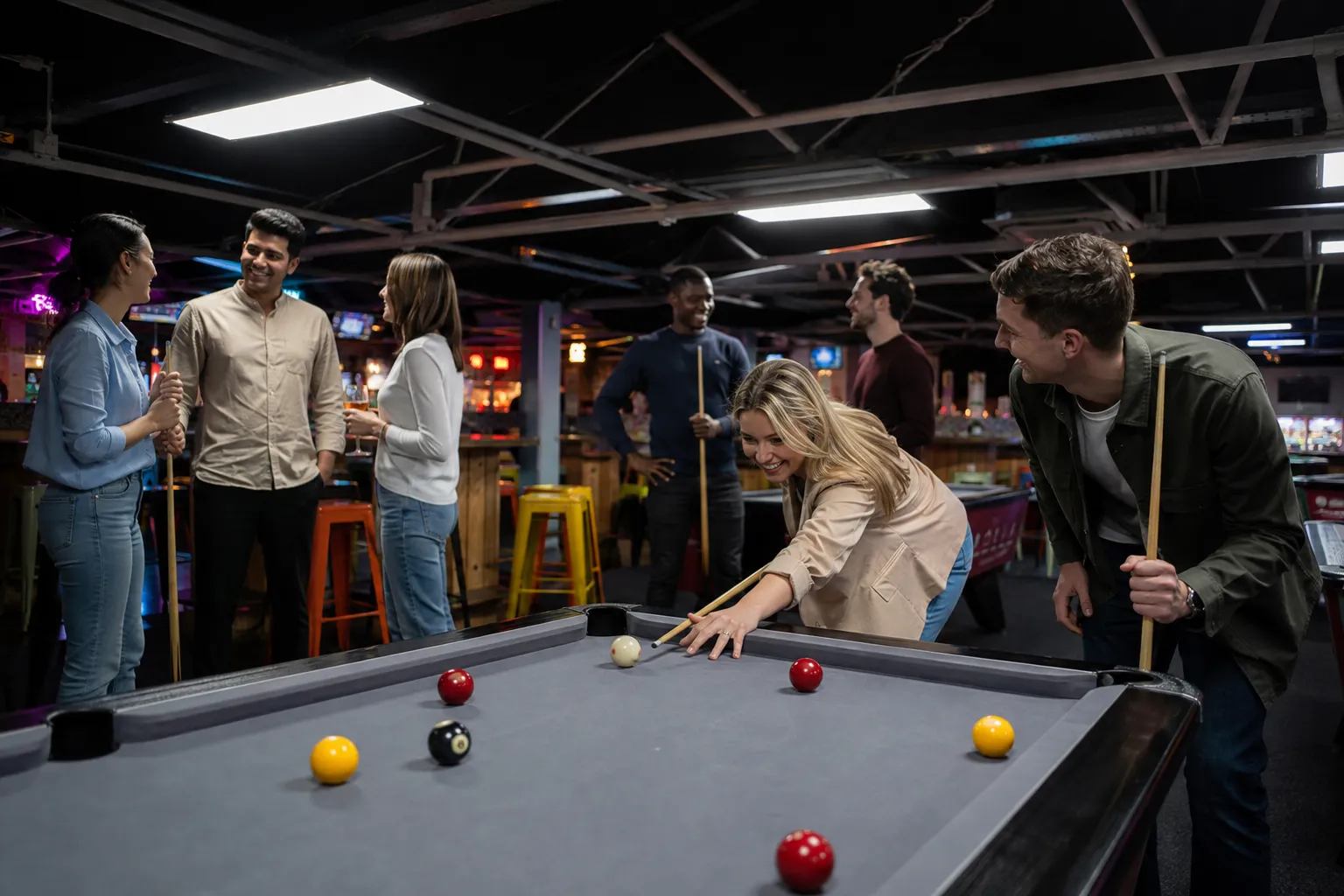
There are many types of company group activities, but they do not all belong in the same setting. A scavenger hunt or obstacle course may suit an outdoor away day. A murder mystery can work for a themed evening. A virtual escape room may help remote colleagues interact, while a cooking challenge requires a suitable kitchen and specialist organisation.
These activities are not offered at Legends. The venue’s strengths are English and American pool, darts, shuffleboard, live sports, food, drinks and a relaxed social atmosphere. Being clear about that distinction protects accuracy and helps organisers choose the right experience.
Other common group activities for work include workshops, volunteering, quizzes and problem-solving exercises. The most suitable option depends on the team’s aim, available time and comfort level. If the goal is lively face-to-face interaction with minimal setup, game-led formats at Legends give people an immediate shared focus.
For organisers comparing search terms, the following phrases often describe similar needs:
- fun work group activities usually prioritise enjoyment and informal connection;
- team bonding activities for work focus on relationships and shared experiences;
- team meeting activities may include a defined learning or discussion outcome;
- company group activities cover socials, celebrations and organised away days;
- team bonding games for work use play to help colleagues interact;
- team ice breakers for work are short openers for unfamiliar groups;
- team work activities usually involve a shared goal or combined result;
- work team games add rules, scores or friendly competition;
- small group activities for adults give every participant a visible role.
Whatever phrase brings you to the planning stage, judge an activity by how well it suits your actual colleagues. Novelty alone does not make an event useful.
How Should You Plan the Event?
1. Set one clear purpose
Choose the main aim before selecting the games. Is the event for new starters, cross-department communication, a project celebration or a relaxed works social? One clear purpose makes the remaining decisions easier.
2. Confirm the practical details
Prepare your preferred date, alternative dates, approximate attendance, timings and budget. Decide whether you want structured games, casual play, food, drinks, live sports viewing or private hire.
The Legends group booking form asks for the occasion, date, time, number of attendees, age range, food requirements, activity preferences and approximate budget. Providing these details helps the venue understand the event you want.
3. Design balanced teams
Mix departments, seniority levels and experience where appropriate. Avoid creating one highly skilled side and several beginner teams. Rotate pairs between rounds so more colleagues work together.
4. Explain rules and scoring
Keep the briefing short and give participants a written or visible rotation if several games are involved. Explain how points are earned, how long each round lasts and what happens if a match is unfinished.
5. Leave time for food and conversation
Do not fill every minute with structured play. Breaks allow colleagues to talk and help the event feel social. Legends serves classic burgers with fries, stone-baked pizzas, hearty mains, sharing plates and bar snacks, supported by a fully stocked bar plus hot and cold drinks. View the current Legends food menu and discuss group food and drink requirements when booking.
6. Finish with a brief debrief
A debrief can take five minutes. Ask:
- What helped your side communicate?
- When did the plan need to change?
- What did a teammate do well?
- What would the team repeat at work?
These questions help connect the event to workplace collaboration without turning the social into a lecture. Keep the tone appreciative and do not use the results to assess individuals.
Example Two-Hour Team Building Schedule
| Time | Activity | Purpose |
| 0 to 15 minutes | Arrival, drinks and practice turns | Help people settle in |
| 15 to 25 minutes | Welcome, rules and team allocation | Set a friendly tone |
| 25 to 55 minutes | Pool doubles rotation | Encourage tactics and communication |
| 55 to 80 minutes | Darts team challenge | Build focus and mutual support |
| 80 to 105 minutes | Shuffleboard pairs | Practise shared strategy |
| 105 to 115 minutes | Final round | Create a memorable shared moment |
| 115 to 120 minutes | Results and quick reflection | Celebrate and capture useful lessons |
This is an example, not a fixed Legends package. The most suitable running order depends on attendance, availability, the games chosen and whether the booking includes food, drinks, live sport or private hire.
Why Choose Legends for Work Group Activities in Braintree?
Legends gives colleagues a relaxed setting where the activity is already built in. It is a sports and pool bar rather than a formal training centre, so teams can enjoy genuine conversation while playing games, sharing food or watching a fixture.
Corporate and group options include:
- Pool tournaments, darts competitions and shuffleboard challenges
- Private hire with exclusive access to the games area and dedicated service
- Tailored food and drink packages for business groups
- Informal meetings and after-work gatherings
- Sports viewing parties on multiple HD screens
- Free on-site parking
The venue is open to everyone and no membership is required. Walk-ins are welcome, although booking ahead is recommended for groups and busy periods. Businesses can read more about corporate team building in Essex or contact Legends with specific questions.
Regular visitors can ask at the venue about the optional Legends Players Club Card. It costs £10 per year and provides 20% off pool and shuffleboard hire, weekly cardholder offers and priority event access. The card is available in the venue and is not required for entry.
Frequently Asked Questions
What are work group activities?
Work group activities are shared experiences that help colleagues interact outside their usual tasks. They may involve competition, cooperation, conversation or problem-solving. At Legends, the confirmed options are pool tournaments, darts competitions and shuffleboard challenges.
Which activities are best for communication?
Pool doubles and shuffleboard pairs encourage people to discuss tactics before acting. A darts team challenge also creates opportunities for encouragement and shared scoring. The best format gives every person a turn and keeps the atmosphere supportive.
Are Legends activities suitable for beginners?
Yes. Organisers can include practice turns, simple scoring, balanced teams and rotating pairs. Nobody needs to be an expert to take part in a social pool, darts or shuffleboard format.
How many games does Legends have?
Legends has 10 English pool tables, two full-size American pool tables, five dart boards and one 14ft shuffleboard table.
Can food and drinks be included in a company event?
Yes. Legends offers tailored food and drink packages for business groups. Discuss the group’s preferences, allergies and dietary requirements directly when enquiring so the available arrangements can be confirmed.
Does a company need membership to visit Legends?
No. Legends is a non-membership venue. The Players Club Card is an optional annual discount card for regular visitors, not an entry requirement.
Is parking available?
Yes. Legends provides free on-site parking for guests.
How can a business book a team event?
Use the group booking enquiry form or contact the venue. Include the preferred date, expected attendance, activities, food and drink requirements, approximate budget and whether private hire is being considered.
Plan Your Next Team Event at Legends
Effective team building does not need forced speeches, elaborate props or a long list of exercises. Give colleagues a shared challenge, mix the teams, keep the competition welcoming and leave space to talk. Pool, darts and shuffleboard can provide all of that in one lively Braintree venue.
If you are looking for work group activities in Braintree or Essex, enquire about a group booking at Legends. Share your date, group size and preferred games, and the team can help you discuss an event built around Legends’ confirmed activities and corporate options.