By Legends Sports & Pool Bar Editorial Team · Updated 2026-08-06
Group building games give colleagues a chance to communicate, solve problems and enjoy friendly competition away from their usual roles. At Legends Sports & Pool Bar in Braintree, teams can turn pool, darts and shuffleboard into lively challenges that encourage teamwork without making the day feel like another meeting.
With 10 English pool tables, two full-size American pool tables, five dart boards and one 14ft shuffleboard table, Legends can host team building for businesses in Braintree and across Essex. Corporate bookings, private hire, tailored food and drink packages, live sport on multiple HD screens and free on-site parking make it easy to bring workmates together in one welcoming venue.
Key Takeaways
- The most useful team building games give everyone a role, create a shared goal and leave time for reflection afterwards.
- Pool tournaments, darts competitions and shuffleboard challenges can develop communication, trust, camaraderie and practical collaboration through friendly competition.
- A mix of individual rounds, pairs and small-team challenges helps different personalities and ability levels contribute.
- Legends is a family-run, non-membership sports and pool bar in Braintree where walk-ins are welcome and advance booking is recommended for group events.
- Businesses can enquire about a group booking and discuss games, private hire, food and drink requirements with the Legends team.
Why Do Group Building Games Improve Team Dynamics?
Good team building creates a shared experience with a clear purpose. People have to listen, take turns, offer encouragement and adapt when a plan does not work. Those behaviours also matter in the workplace, where colleagues need to exchange information, make decisions and rely on one another.
The CIPD evidence review on high-performing teams identifies trust, psychological safety, team cohesion, shared thinking, information sharing and reflection as important parts of team effectiveness. It also recommends well-planned interventions such as team building, teamwork training and debriefing.
A social game will not solve every workplace challenge on its own. Its value comes from giving teammates a low-pressure way to practise useful behaviours and see one another differently. A quiet colleague may show hidden tactical ability at the pool table. Someone who rarely leads meetings may be excellent at explaining a darts strategy. These moments can build empathy and respect across a group.
How Do Games Build Communication and Trust?
Every game creates small decisions. Who goes first? What is the safest shot? Should the team take a risk or protect its lead? To answer those questions, players have to share ideas clearly and trust other people to act on them.
That process can support psychological safety when the atmosphere remains friendly. Google’s research into team effectiveness found that how a team works together mattered more than who was on it, with psychological safety identified as the most important dynamic in the teams studied. At a social event, leaders can support this by keeping the tone encouraging, treating mistakes lightly and making space for everyone to participate.
Trust grows through repeated, manageable moments. A player asks for advice, a teammate offers a suggestion, and the pair deal with the outcome together. It is simple, but it gives people a chance to collaborate outside normal workplace pressure.
Why Are Small Teams So Effective?
Smaller sides make participation visible. In pairs or groups of three to five, each person takes a turn and has a reason to contribute. This makes team building small group activities particularly useful for encouraging quieter colleagues without putting them on the spot.
Small sides can also be changed between rounds. Rotating the line-up helps people work with colleagues outside their usual department, while a points table keeps the whole room invested. For larger company groups, several matches can run at the same time before winners progress to a final.
The Best Team Building Games to Play at Legends
The strongest format for Legends uses the games already available at the venue. No invented obstacle course, specialist equipment or awkward role-play is needed. The activities below can be adapted around the number of attendees, the time available and the group’s confidence level.
1. Team Pool Tournament
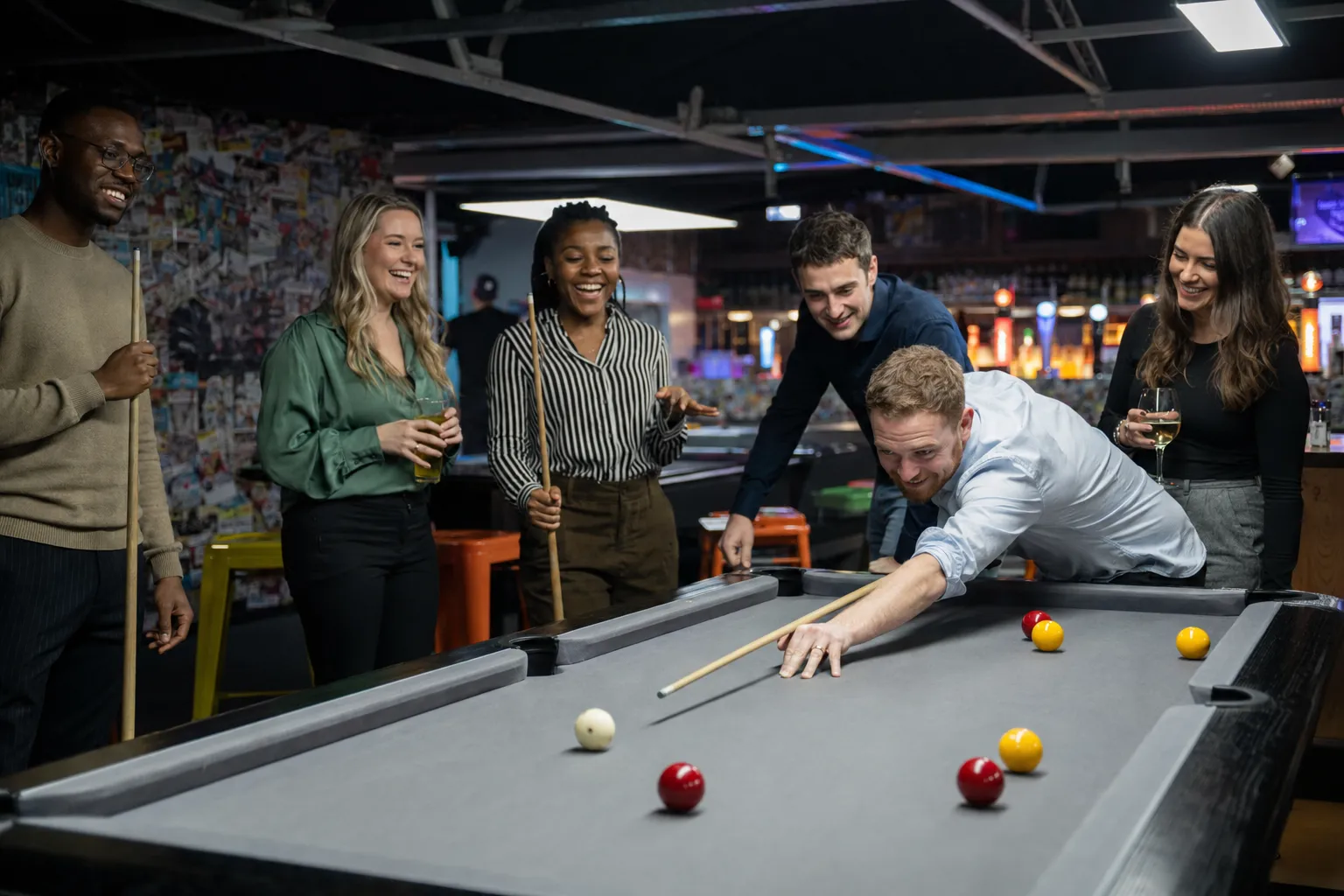
A pool tournament is one of the most flexible games for team events because its format can be simple or strategic. Legends has 10 English pool tables and two full-size American pool tables, allowing several matches to take place during a group booking.
Try this structure:
- Split colleagues into balanced sides.
- Begin with doubles so players have to discuss shot choices.
- Award points for each match rather than eliminating people immediately.
- Rotate partners between rounds to widen collaboration.
- Finish with a final and a light-hearted presentation.
Doubles naturally encourages communication because teammates must read the table together. Experienced players can share knowledge, while beginners still influence tactics and scoring. A simple handicap, such as pairing confident and new players together, can keep the contest close without making ability the sole focus.
Pool also creates natural pauses for conversation. Unlike an activity that demands constant movement, it leaves enough space for colleagues to chat, watch other matches and build camaraderie between turns.
2. Darts Team Challenge
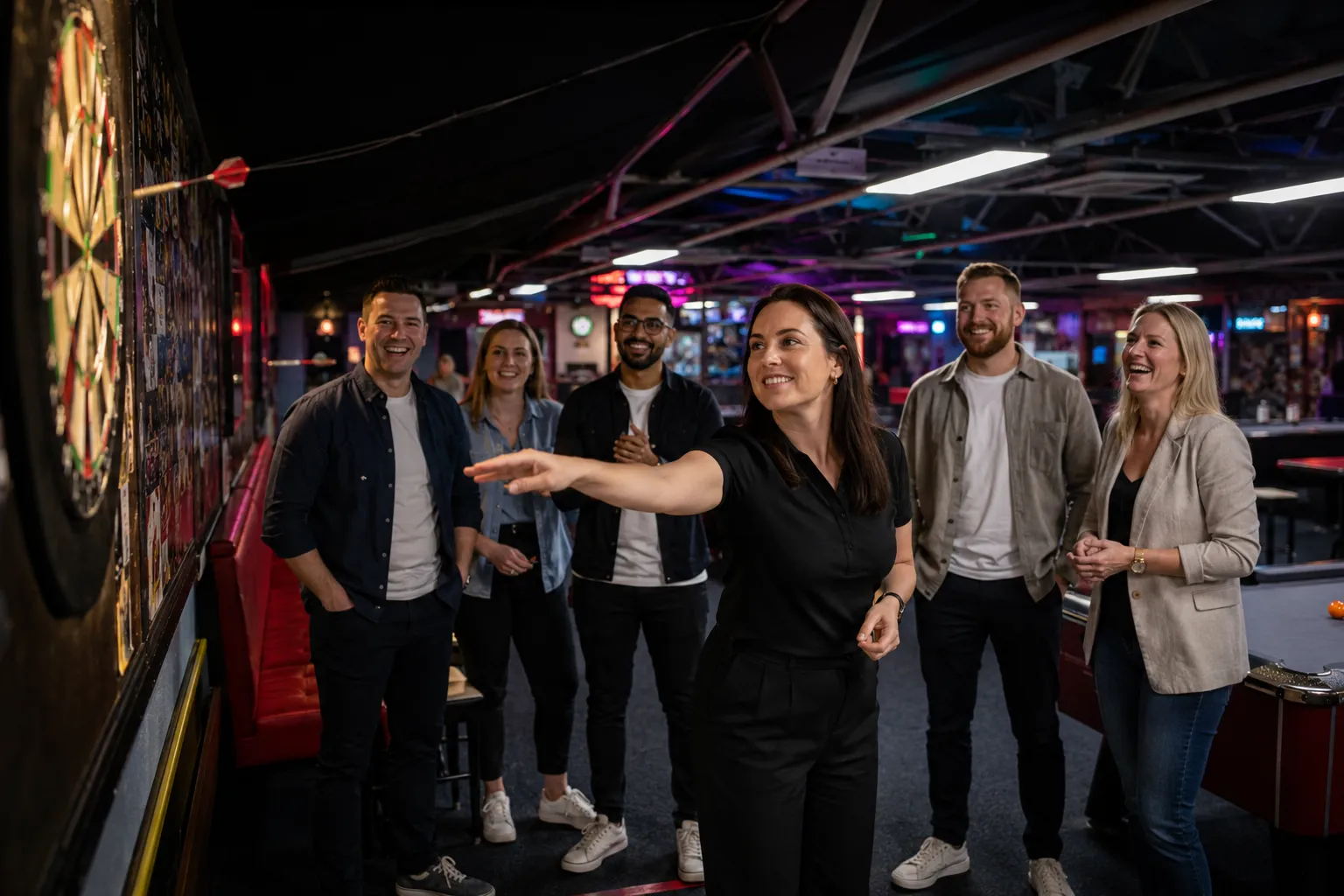
Legends has five well-maintained dart boards, and darts are free with any purchase. A darts challenge works well for mixed experience levels because the organiser can vary the objective rather than relying only on a traditional match.
Possible rounds include:
- Highest combined score from a fixed number of throws
- Nearest to the bull
- Team countdown, with every participant contributing
- Target ladder, where teams aim for a sequence of numbers
- Pressure round, where the final player can win bonus points
These work team games reward calm communication and mutual support. They also make it easy to recognise improvement, not just the highest score. Encourage each side to choose its throwing order and discuss how it will approach the round. That small amount of planning turns casual play into a genuine exercise in teamwork.
3. Shuffleboard Strategy Challenge
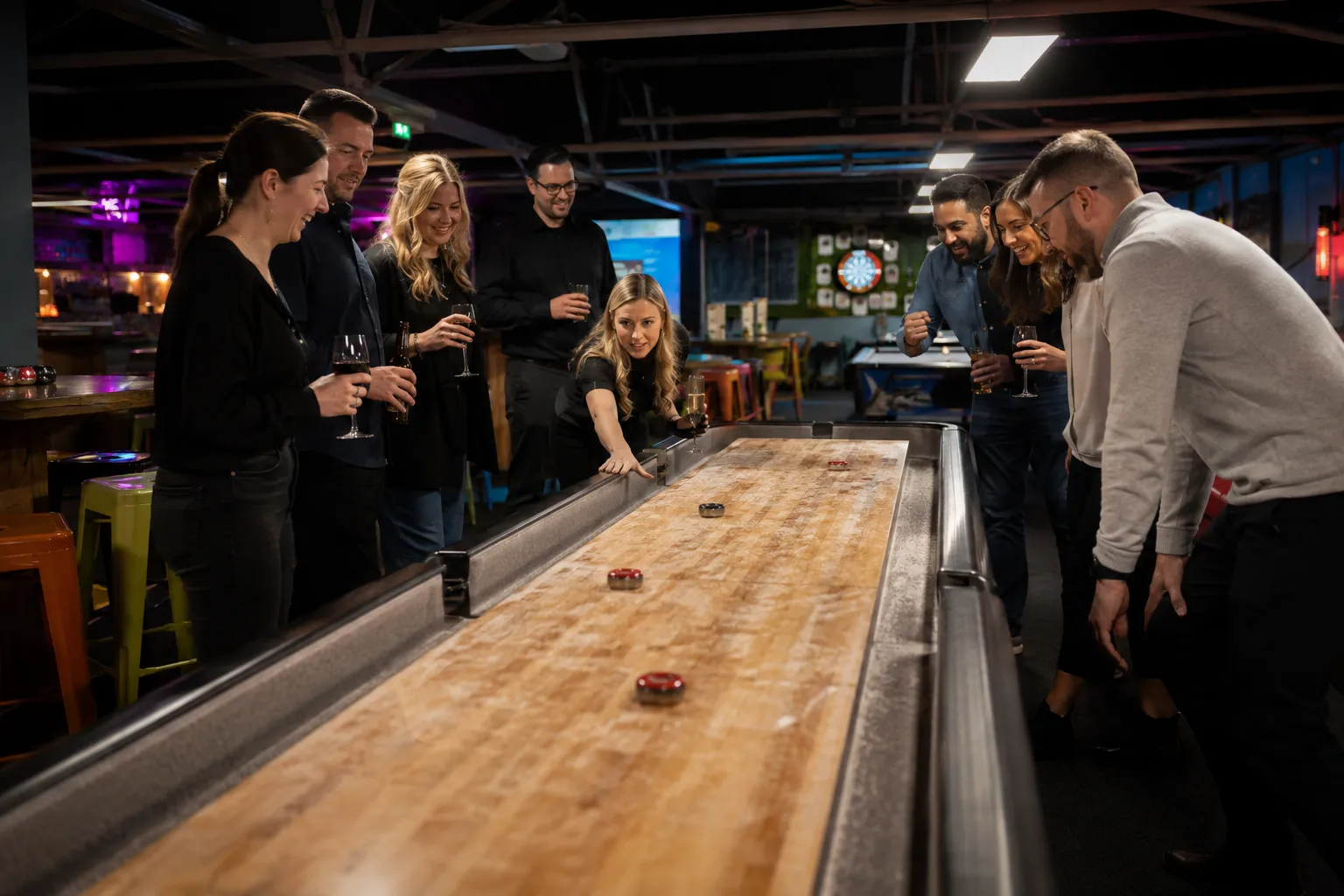
The 14ft shuffleboard table creates a different kind of contest. Players need control, judgement and an awareness of where every puck may finish. A strong shot can score points, protect another puck or block an opponent.
Use pairs and ask them to agree a plan before each turn. This makes the activity about communication and shared decision-making as well as accuracy. Change partners during the session so more colleagues learn to collaborate. Because the rules are quick to understand, shuffleboard can act as an icebreaker before the pool or darts rounds begin.
4. Mixed Legends Games League
For groups that want variety, combine pool, darts and shuffleboard into one points-based league. Teams collect points at each station, then add their totals at the end.
| Round | Main skill | Simple scoring idea |
|---|---|---|
| Doubles pool | Planning and communication | Points for a win, plus a sportsmanship bonus |
| Darts target round | Focus and encouragement | Combined team score |
| Shuffleboard pairs | Strategy and control | Total points across a set number of ends |
| Final challenge | Adaptability | Bonus round for the leading teams |
This is one of the most practical team work activities for a company social because no single type of player dominates every round. It rewards adaptability, gives people more chances to contribute and keeps the pace moving.
5. Sports Prediction Challenge
Legends shows live sport across multiple HD screens, including football on Sky Sports, TNT Sports and Amazon Prime, plus rugby, Formula 1, golf, boxing and women’s football. If a major fixture coincides with the booking, teams can submit score predictions or answer a short sports trivia round before play begins.
Keep this as an optional extra rather than the entire event. It suits sports fans and creates conversation, while the pool, darts and shuffleboard rounds remain accessible to colleagues who do not follow a particular league or competition. Businesses can read more about live sports at Legends.
More Group Activities for Different Workplaces
Not every format belongs in every venue. A scavenger hunt may suit an outdoor away day, a murder mystery can suit a themed evening, and a virtual escape room may help remote colleagues interact online. Popular ideas such as two truths and a lie, the human knot and a small team ice breaker can also start a session elsewhere.
At Legends, the strongest approach is to use real games in a relaxed social setting. Pool, darts and shuffleboard require no pretend scenario, and the friendly competition gives colleagues something immediate to discuss. Businesses searching for fun work group activities can build a complete event around these games, food, drinks and live sport without moving between several venues.
The following phrases often describe overlapping formats:
- team meeting activities usually have a work-related learning goal;
- company group activities can include socials, celebrations and away days;
- team ice breakers for work help unfamiliar colleagues start talking;
- group activities for work are a broad category covering games and structured exercises;
- team bonding games for work focus on relationships and shared enjoyment;
- fun team ice breakers are short, low-pressure openers;
- small group activities for adults work best when every person has a clear turn;
- group activities for small groups can use one table or dart board;
- group activities for adults should feel natural, inclusive and age-appropriate;
- fun group activities prioritise enjoyment alongside interaction;
- fun group activities for adults work well when rules are easy to learn;
- group bonding activities create shared memories outside everyday routines;
- fun team activities combine participation with friendly competition;
- team ice breakers should prepare the group for the main event;
- team meeting ice breakers can introduce the theme or split people into sides;
- group building activities work best with a clear purpose and simple structure;
- team bonding games can reveal how people encourage and support one another;
- team meeting games need a defined time limit and outcome;
- games for team events should suit different confidence and ability levels.
For local organisers searching for team activities near me, the key question is not how many different games a venue advertises. It is whether the activity, atmosphere and practical arrangements fit the people attending.
How to Plan a Team Building Event That People Enjoy
1. Decide What You Want to Improve
Choose one or two aims. You might want new starters to feel welcome, departments to communicate more easily, or colleagues to enjoy time together after a demanding project. A clear purpose helps you select the right format and avoids vague facilitation.
If communication is the priority, use doubles and require pairs to agree tactics. If innovation is the focus, add a creative rule or ask teams to devise their own scoring challenge. If the aim is camaraderie, leave more time for food, conversation and watching the final together.
2. Make Participation Inclusive
Do not assume everybody already knows how to play. Explain the rules briefly, allow practice turns and mix experience levels. Avoid making less confident participants feel responsible for a loss.
Balanced teams improve the experience. Give participants different ways to help, such as playing, keeping score, choosing tactics or encouraging teammates. This allows people to contribute without forcing everyone into the same role.
3. Keep the Competition Friendly
A scoreboard can add energy, but the tone matters more than the prize. Reward positive behaviour as well as results. A bonus for the best comeback, clearest communication or strongest team spirit can keep the event welcoming.
The organiser should intervene if one person controls every decision. Good team building depends on shared involvement. Rotate captains, partners and playing order to distribute responsibility.
4. Build in Time to Talk
Do not schedule every minute. Conversation between rounds is part of the value, especially for colleagues who rarely work together. Food and drink can give the event a natural second half once the formal competition has finished.
Legends offers a fully stocked bar, classic burgers with fries, stone-baked pizzas, hearty mains, sharing plates and bar snacks. Corporate groups can discuss tailored food and drink options when booking. The current selection can be checked through the Legends food menu.
5. Finish With a Short Debrief
A debrief does not need to feel like training. Ask three quick questions:
- What helped your team perform well?
- When did you have to change your plan?
- What did a teammate do that helped you?
These questions connect the experience to communication, trust and collaboration without draining the fun from it. They can also reveal practical lessons about listening, role clarity and decision-making.
A Simple 90-Minute Event Format
| Time | Activity | Purpose |
| 0 to 10 minutes | Welcome, rules and team allocation | Set expectations and introduce the group |
| 10 to 35 minutes | Doubles pool rounds | Practise tactics and clear communication |
| 35 to 55 minutes | Darts challenge | Build focus and mutual encouragement |
| 55 to 75 minutes | Shuffleboard pairs | Test planning and adaptability |
| 75 to 85 minutes | Final round | Create a shared highlight |
| 85 to 90 minutes | Results and quick reflection | Celebrate and capture useful lessons |
This is an example, not a fixed package. The best schedule will depend on group size, availability and whether food, drinks, live sports viewing or private hire are included. Contact Legends to discuss the right arrangement for your business.
Why Choose Legends for Team Building in Braintree?
Legends combines organised group fun with the atmosphere of a family-run sports and pool bar. It is not a formal training centre, so colleagues can relax and interact naturally. It is also a non-membership venue, which means nobody needs to join a club to visit.
Corporate and group options include:
- Pool tournaments, darts competitions and shuffleboard challenges
- Private hire with exclusive access to the games area and dedicated service
- Tailored food and drink packages for business groups
- Informal meeting and event space
- Sports viewing parties on multiple HD screens
- Free on-site parking
Walk-ins are welcome, but advance booking is recommended during busy periods and for team events. Businesses can use the group booking form to share the occasion, preferred date and time, expected attendance, activity choices, food requirements and approximate budget.
Regular visitors can also ask in the venue about the Legends Players Club Card. It costs £10 per year and provides 20% off pool and shuffleboard hire, along with weekly cardholder offers and priority event access. The card is optional and is not required to enter Legends.
Frequently Asked Questions
What are group building games?
They are shared challenges designed to help people interact, communicate or solve a problem together. They can be competitive or cooperative, but the best versions give every participant a meaningful role.
Which activities can corporate groups play at Legends?
Legends can host pool tournaments, darts competitions and shuffleboard challenges. Groups can also discuss private hire, food and drink packages, informal event space and sports viewing parties.
Are the activities suitable for beginners?
Yes. Pool, darts and shuffleboard can all be adapted for mixed experience levels through practice turns, balanced teams, doubles formats and simple scoring rules.
How many pool tables does Legends have?
Legends has 10 English pool tables and two full-size American pool tables. The venue also has five dart boards and one 14ft shuffleboard table.
Do companies need a membership to visit?
No. Legends is a non-membership venue. The Players Club Card is an optional annual discount card for regular visitors, not an entry requirement.
Is parking available?
Yes. Legends provides free on-site parking for guests.
Can food and drinks be included?
Yes. Legends offers tailored food and drink packages for business groups. Available food includes classic burgers, stone-baked pizzas, hearty mains, sharing plates and bar snacks, supported by a fully stocked bar and hot and cold drinks.
How do I book a corporate event?
Complete the Legends group booking enquiry form or contact the venue to discuss your group, preferred date, activities, food and drink requirements, and private hire options. Advance booking is recommended for group events.
Plan Your Group Event at Legends
The best workplace events feel enjoyable first and useful second. Pool, darts and shuffleboard create natural opportunities to communicate, plan, compete and laugh together. Add food, drinks or a live fixture, and the result is a company social that gives colleagues a real shared experience.
If you are planning team bonding activities for work in Braintree or Essex, explore team building at Legends and send the team your preferred date, group size and ideas. Legends will help you shape a lively event around the venue’s confirmed games and corporate options.